8 May 2025
GEOTHERMICA Initiative at the Polish Presidency Conference in Kraków
Europe's Underground Energy: Kraków Puts Geothermal at the Heart of EU Policy
Beneath Europe's feet lies an enormous, largely untapped source of clean energy. It doesn't depend on the weather. It doesn't require vast tracts of land. And it has been heating homes in Iceland, Italy, and parts of Central Europe for decades. Yet across most of the EU, geothermal energy remains conspicuously absent from the national energy plans that will determine whether Europe meets its climate targets.
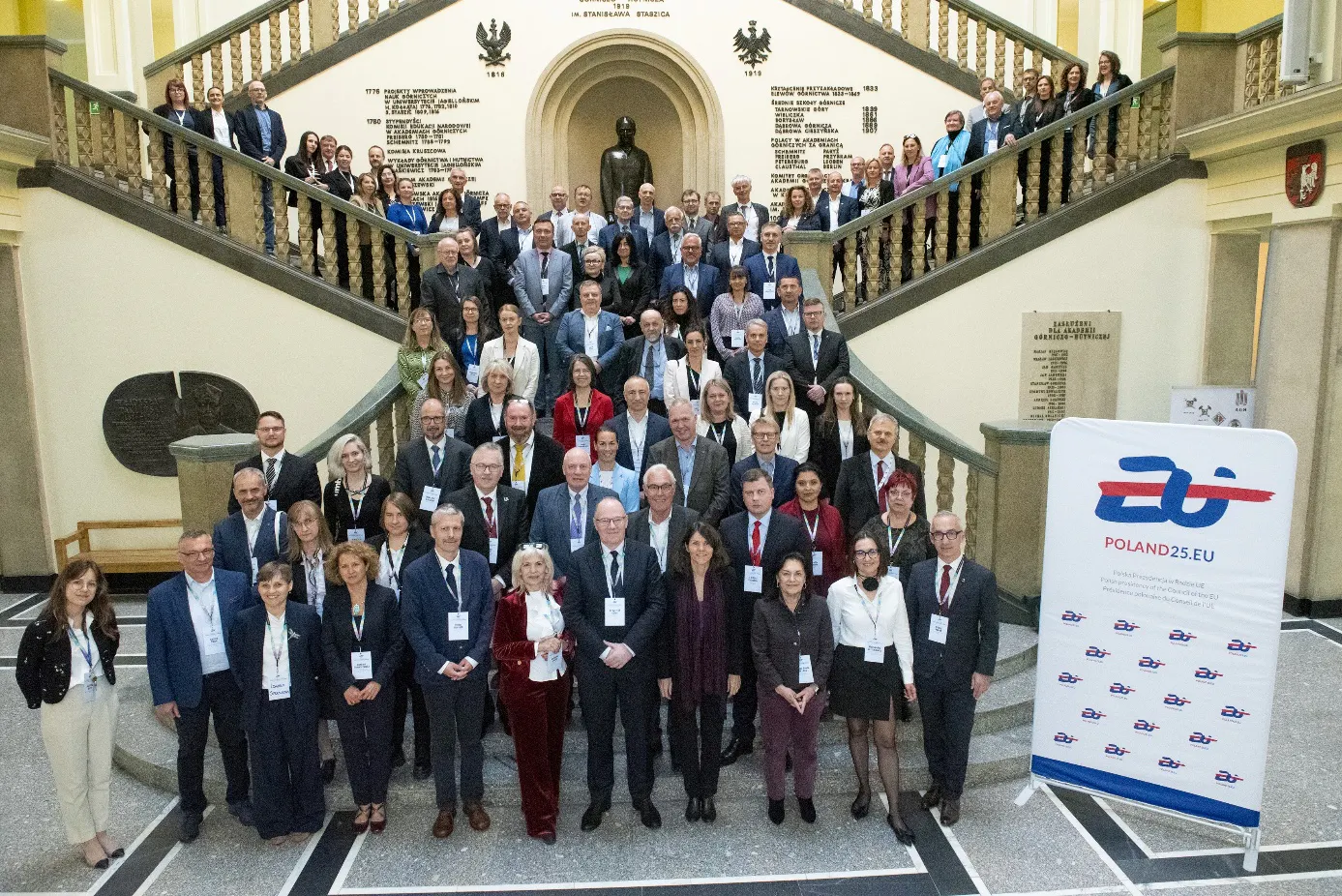
That gap, between what geothermal can deliver and what policy has so far enabled, was the subject of a high-level conference in Kraków on 7–8 May 2025, organised under the Polish Presidency of the Council of the EU. We were there. And what we witnessed was a genuine shift in how Europe's policymakers are beginning to talk about geothermal.
From the lecture hall to the boreholes
The conference, hosted at AGH University of Krakow and organised by the Polish Geological Institute, National Research Institute, brought together representatives from across EU member states for a programme that moved deliberately from strategy to ground truth. Day one examined national policy frameworks, the enabling role of geological surveys, and the structural barriers that continue to slow deployment across the EU. Day two took participants out of the conference hall entirely,to the geothermal operations of PEC Geotermia Podhalańska SA in Bańska Niżna and the Chochołowskie Thermal Baths, where Poland's geothermal potential is already, quietly, being realised.
It was a deliberate design choice, and an effective one. Abstract discussions about regulatory frameworks and investment risk land differently when you are standing next to infrastructure already delivering renewable heat to thousands of households.
The uncomfortable question and our Co-Chair leading it
The most important session of the day was the one that asked the most uncomfortable question: given everything Europe knows about geothermal energy, its reliability, its low carbon footprint, its potential to decarbonise heating across the continent, why is deployment still so slow?
Our Co-Chair, Paul Ramsak, led that discussion in Panel Session III on Benefits and Barriers to Geothermal Development: Perspectives on Geothermal Energy in the EU. The answers the panel surfaced were not new, but hearing them debated at a Presidency-level event gave them fresh urgency. Regulatory frameworks remain fragmented across member states, making it difficult for developers to navigate permitting, even when the geological case is clear. Access to standardised subsurface data is inconsistent at best. And the upfront cost profile of deep geothermal drilling continues to deter private capital that public funding alone cannot replace.

This is precisely the territory GEOTHERMICA was built to address. Our model of cooperation of national public authorities, pooling mandates and coordinating research to de-risk investment, exists because these barriers cannot be solved country by country. Ramsak was well placed to make that case, and he did.
What Germany's experience tells us, and why it matters for Europe
In the Panel Session on Strategic Documents on Geothermal Energy in Various Countries, our member Stephan Schreiber brought a perspective that deserves wider attention. Germany, and Bavaria in particular, has quietly built one of Europe's most impressive deep geothermal district heating networks. It did not happen overnight or by accident; it required sustained policy commitment, public investment in geological data, and a regulatory environment that gave developers enough certainty to drill.

As a GEOTHERMICA member, Germany's trajectory matters well beyond its own borders. The knowledge generated in geothermal fields, about reservoir behaviour, drilling techniques, and heat network integration, is exactly the kind of hard-won experience that our cross-border coordination exists to transfer to countries earlier in their geothermal journey. Schreiber's contribution connected that national story to the European question every delegation in the room was quietly asking: what does a credible geothermal strategy actually require, and are we serious about building one?
A network that is growing
One of the outcomes of the Kraków conference was the connections made with potential new GEOTHERMICA members. For us, this is not a membership statistic; it reflects a genuine shift in how national authorities across Europe are beginning to see geothermal: not as a local speciality, but as a strategic asset worth coordinating at the European level. We look forward to welcoming new members into the network and to the knowledge and ambition they will bring with them.
The bigger picture
The decision by the Polish Presidency to dedicate a high-level conference to geothermal energy is itself worth noting. Poland's energy story has long been dominated by coal. That a Polish Presidency would place geothermal on the EU agenda, and do so with genuine depth and seriousness, signals that the political ground is shifting in ways that matter.
Europe has the geology. It increasingly has the technology. What has been missing is the policy alignment and coordinated investment that turns potential into installed capacity. Events like Kraków do not solve that problem alone, but they are how the problem begins to get solved. GEOTHERMICA's role is to ensure that when Europe is ready to move, the knowledge base, the partnerships, and the coordination infrastructure are already in place.
We will keep showing up.

